Physical Address
3260 College Rd, Fairbanks, Alaska

By Derek V. Mackown | IT Technician & Display Hardware Specialist
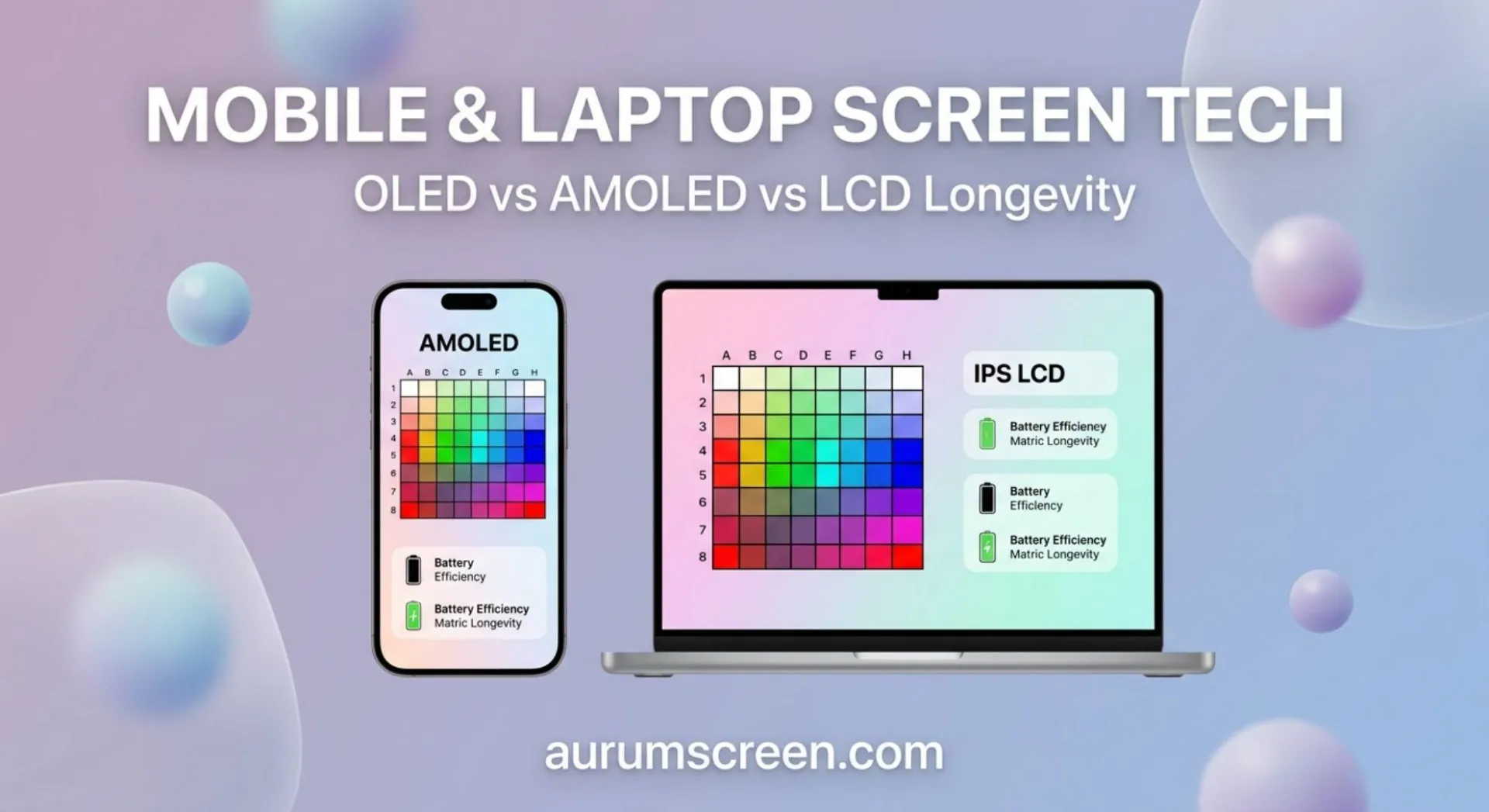
This question gets asked wrong almost every time. People phrase it as “which technology is better” and the answer to that question depends entirely on what you mean by better and for what purpose. Asked as a longevity question specifically, which one keeps working correctly for the longest time under real-world conditions, it has a more defensible answer. Not a simple one, but a defensible one.
I’ve watched all three technologies age in the field. I’ve replaced OLED panels that failed at 18 months and LCD panels that were still performing adequately at seven years. I’ve seen AMOLED displays on daily-driver phones that showed no visible degradation after three years and others that burned in within six months of the same usage pattern. The technology itself is only part of the longevity story. Manufacturing quality, usage behavior, thermal environment, and brightness habits contribute as much as the underlying panel technology.
What follows is a careful examination of each longevity dimension, not a review of image quality, not a purchase guide based on brightness or color volume, but a specific analysis of how each technology fails, how quickly, under what conditions, and what that means for how long you can realistically expect accurate, uncompromised performance from each.
Table of Contents
ToggleBefore comparing longevity, a clear definition of what each term means in 2025 is necessary, because the categories are less distinct than marketing suggests.
LCD (Liquid Crystal Display) is the broadest category. It encompasses IPS (In-Plane Switching), TN (Twisted Nematic), and VA (Vertical Alignment) panel types, all of which use a backlight separate from the pixel layer. The liquid crystals don’t emit light, they modulate it. The backlight does the emitting, and the crystal layer controls what passes through for each pixel.
Consumer laptops overwhelmingly use IPS LCD. Budget monitors and older laptops use TN. High-contrast monitors and some televisions use VA. For longevity purposes, IPS is the representative LCD technology, TN and VA share the same backlight-dependent failure modes but differ in other characteristics.
OLED (Organic Light-Emitting Diode) describes any display where each pixel generates its own light directly from an organic compound. No backlight. The pixel is both the light source and the color filter simultaneously. OLED is used in high-end smartphones, premium laptops (Dell XPS, ASUS ProArt, HP Spectre), and the majority of OLED televisions.
AMOLED (Active Matrix OLED) is a specific implementation of OLED technology developed primarily by Samsung Display. The “Active Matrix” refers to the thin-film transistor backplane used to address individual pixels, the same addressing architecture used in LCD panels, applied to an OLED emitter layer. Structurally, AMOLED is OLED. The meaningful differences are in the specific organic compound formulations Samsung uses, the diamond PenTile subpixel arrangement in most Samsung AMOLED displays, and Samsung’s proprietary compensation circuit technology. For longevity comparisons, AMOLED and OLED share the same fundamental aging mechanisms, the distinction appears in the specifics of how quickly those mechanisms progress and how effectively the compensation technology delays visible effects.
Every display technology loses luminance over its operational lifetime. The mechanism and rate differ fundamentally between LCD and OLED/AMOLED.
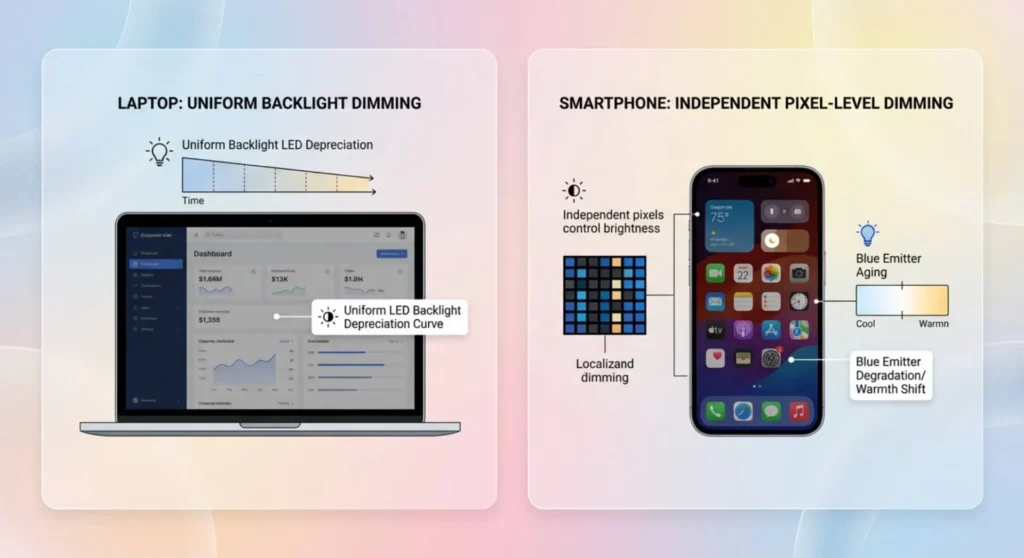
LCD luminance aging is driven by backlight degradation. LED backlights, which have entirely replaced CCFL in modern displays, dim at a rate that follows LED lumen depreciation curves. Under standard operating conditions, a quality LED backlight loses approximately 20 – 30% of its initial brightness over 50,000 hours of operation. At 8 hours daily use, 50,000 hours represents over 17 years. Consumer LCD panels typically reach end of life from other causes, mechanical damage, connector failure, or simply being replaced, before the backlight degrades noticeably.
The relevant real-world LCD luminance figure: most LCD panels retain 70 – 80% of their initial brightness after 5 years of standard use. The degradation is gradual, even, and affects the entire display surface uniformly. There is no local dimming, no region of the screen ages faster than another based on content.
OLED and AMOLED luminance aging is fundamentally different because each pixel is its own light source. Every pixel ages independently, at a rate determined by how hard it’s been driven. A pixel that has spent its life displaying bright white content ages faster than a pixel that primarily displays dark content. This creates differential aging, uneven luminance across the screen surface that correlates directly with the historical content pattern.
The OLED luminance degradation rate at the subpixel level: blue OLED emitters are the fastest degrading component in virtually all current OLED formulations. Red and green emitters degrade more slowly, green being the most durable. The differential degradation between channels is part of why aged OLED displays develop a yellow or warm color cast: the blue channel has degraded further than red and green, shifting the white point toward warmth.
Samsung’s AMOLED compensation circuits actively measure per-pixel aging and adjust drive current to compensate, maintaining more uniform luminance for longer than uncompensated OLED. Samsung Display has published LT97 ratings (the brightness level at which the display reaches 97% of initial luminance) for their AMOLED panels. Current high-end AMOLED achieves LT97 at approximately 300 – 500 nits continuous brightness for 1,000 – 2,000 hours. At 500 nits, peak brightness used for 2 – 3 hours daily with the remainder at lower brightness, this typically translates to 4 – 6 years before compensation can no longer fully mask differential aging.
Verdict on luminance longevity: LCD wins clearly. A quality IPS LCD panel at its native brightness setting will outlast any current OLED or AMOLED panel in terms of maintaining uniform luminance across the full screen surface. The gap narrows significantly under conservative OLED brightness habits, an AMOLED device used primarily at 40–60% brightness ages substantially more slowly than one kept at maximum brightness. The technology disadvantage is real but manageable through usage behavior.
This is the longevity dimension with the starkest divergence between LCD and OLED.
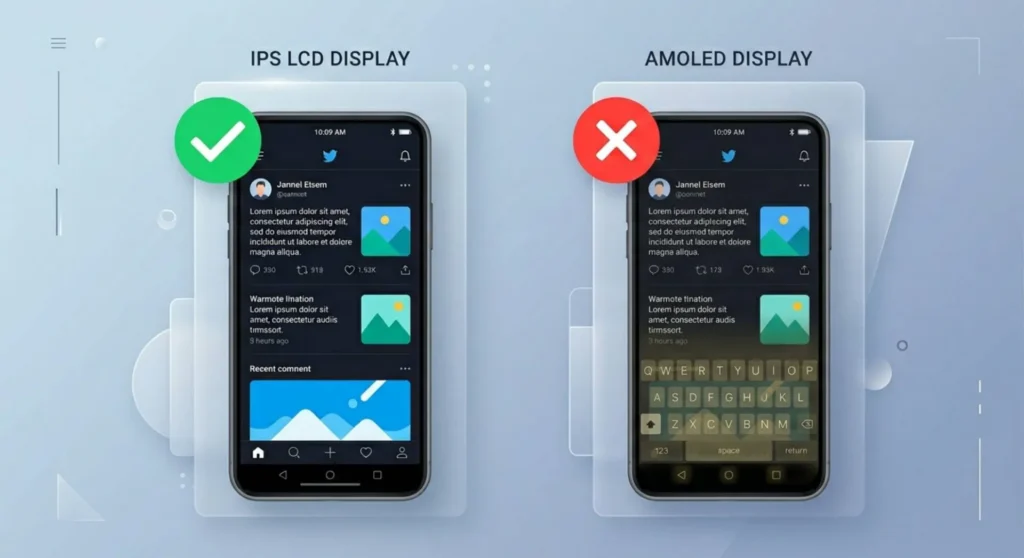
LCD panels are not immune to static content damage, image retention from liquid crystal alignment stress is a real and documented phenomenon, as covered elsewhere in this series. However, IPS image retention is a temporary condition in all but extreme cases. The alignment layer recovers when static stress is removed. Long-term permanent damage from static content on IPS LCD requires extraordinary usage patterns: displaying a static, high-contrast element at maximum brightness for weeks or months continuously. Under normal daily use, the LCD alignment layer does not sustain permanent static content damage.
OLED and AMOLED panels accumulate permanent damage from static content through the differential emitter degradation mechanism. A navigation bar, a taskbar, a game HUD element, or a news ticker, anything that occupies the same screen position continuously, causes measurable and permanent differential wear in that region over weeks to months of standard use. The compensation algorithm delays the visual manifestation, but it cannot prevent the underlying material degradation.
The threshold matters here. Occasional static content, a document open for an afternoon, a pause screen left for an hour, does not produce visible burn-in on modern AMOLED. The organic compounds can sustain significant load without visible degradation when that load is intermittent. Permanent damage accumulates when the same content occupies the same position for cumulative thousands of hours over the panel’s lifetime.
Samsung has published burn-in test results for their AMOLED panels under accelerated aging conditions. Under continuous 600-nit static content, visible burn-in begins appearing at approximately 200 – 300 hours. Under typical smartphone usage patterns with mixed content, visible burn-in typically appears between 18 months and 4 years depending on brightness habits and content patterns.
LG’s WRGB OLED – the technology in most OLED televisions, adds a white subpixel to the standard RGB arrangement. This reduces the load on individual color emitters for white and near-white content. It produces better luminance longevity than standard RGB OLED for television use cases, where large areas of bright content are common. LG television OLED has a considerably better burn-in record than smartphone AMOLED primarily because of this architectural choice.
Verdict on static content vulnerability: LCD wins definitively. No qualification. An IPS LCD panel used for displaying dashboards, financial terminals, retail signage, or any application with persistent static content will outlast an OLED or AMOLED panel by a significant margin in terms of image uniformity. For mixed-use consumer devices, AMOLED’s vulnerability is manageable, for static-content-heavy applications, it is disqualifying.
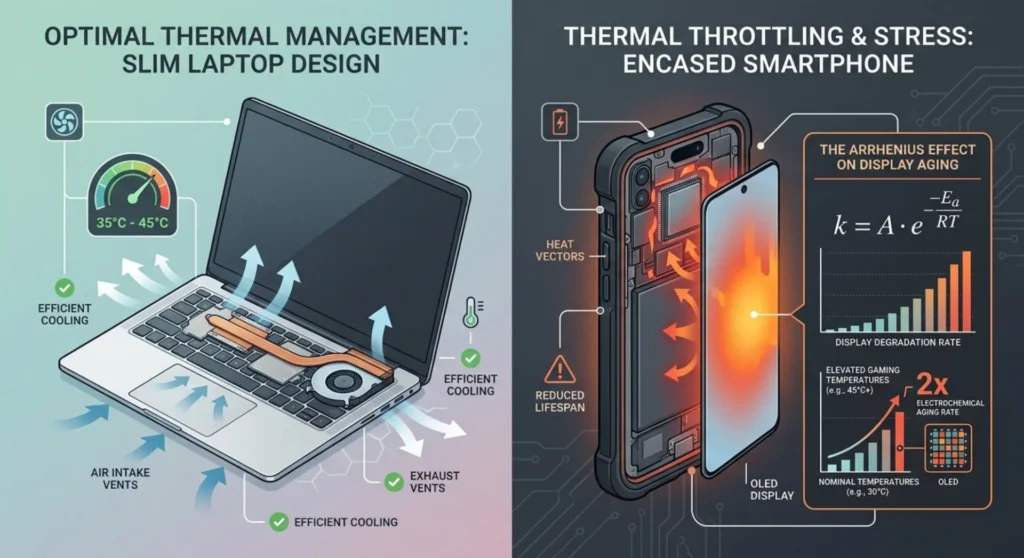
Heat accelerates aging in every display technology, but it does so through different mechanisms and at different rates.
LCD thermal sensitivity is primarily about the backlight. LED backlight efficiency decreases with temperature, LEDs operating continuously at elevated temperatures experience accelerated lumen depreciation. The liquid crystal layer itself has a defined operating temperature range (typically -20°C to 70°C for panel cells) and becomes permanently damaged when operated above its upper limit. Under typical consumer use, LCD panels rarely experience the sustained temperatures that would cause crystal layer damage. Backlight thermal management is the more realistic concern, laptops with inadequate thermal design that keep the display area consistently hot accelerate backlight aging measurably.
OLED and AMOLED thermal sensitivity is more acute because the organic compounds degrade through electrochemical processes that accelerate with temperature. Every 10°C increase in operating temperature roughly doubles the rate of organic compound degradation, a relationship described by the Arrhenius equation that governs most electrochemical aging processes. An AMOLED phone operating at 45°C (common in direct sunlight or during intensive gaming) ages its organic emitters at approximately twice the rate of the same phone operating at 35°C.
This thermal sensitivity is why gaming-intensive use accelerates AMOLED degradation beyond what screen-on time alone would predict, the combination of sustained high brightness during gaming and elevated system temperature compounds the emitter stress. It’s also why phone cases that trap heat are specifically disadvantageous for AMOLED longevity in a way they aren’t for LCD longevity.
Samsung’s most recent AMOLED formulations have improved thermal stability compared to earlier generations. The transition from conventional small-molecule organic compounds to polymer and hybrid organic-inorganic compounds in current generation AMOLED has reduced the thermal degradation rate coefficient meaningfully. This is one of the reasons newer flagship AMOLED devices show better longevity in independent durability tests than equivalents from 2018 – 2020.
Verdict on thermal stress resilience: LCD wins again, but the margin is narrowing with each AMOLED generation. Under cool to moderate thermal conditions, AMOLED longevity has improved to the point where the thermal disadvantage is meaningful only for users in hot climates, heavy gamers, or devices with poor thermal design. For controlled environment applications, desktop monitors, professional workstations, LCD’s thermal resilience advantage is effectively irrelevant because display temperatures are moderate and consistent.
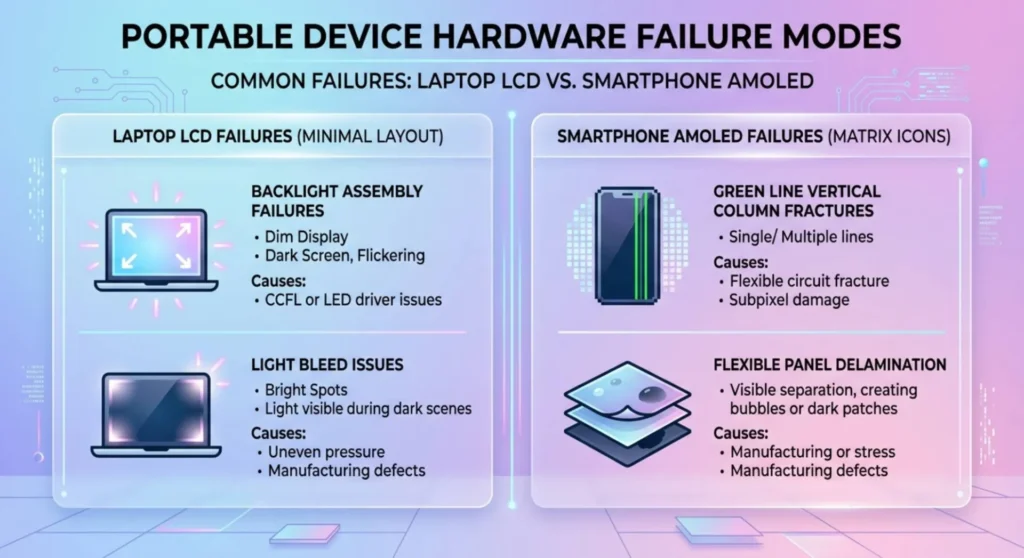
Longevity isn’t just luminance degradation. Displays fail in other ways, and the failure mode distribution differs by technology.
How LCD panels actually fail in practice:
The backlight assembly fails before the LCD cell in most cases. LED backlight failure manifests as dark regions, uneven backlight bleeding, or complete backlight failure with the panel cell still functioning (detectable by the flashlight test, shine a light at the panel and a faint image is visible despite no backlight output). Backlight failure on consumer laptops typically occurs between 5 – 10 years under standard use, or earlier under high-brightness sustained use.
Inverter failure is relevant only to CCFL-backlit panels (pre-2012 laptops primarily), LED-backlit panels have no inverter. Modern LCD failure from the panel cell itself is uncommon under normal use.
The IPS glow and backlight bleed that characterize most IPS panels typically worsen over years as the panel adhesive layers age and develop micro-gaps. This is a cosmetic degradation rather than functional failure but affects image quality.
How OLED and AMOLED panels actually fail in practice:
For consumer smartphones, the predominant failure mode is not burn-in but physical layer separation, delamination of the flexible display stack from repeated flexing (fold cycle fatigue on foldable devices) or from accumulated thermal stress cycles. The display suddenly shows dark patches, pressure sensitivity changes, or the touch layer separates from the emitter layer. This is a structural failure, not an emitter failure.
For flat AMOLED smartphone panels, the second most common failure mode is green line and column failure, transistor column failure in the TFT backplane that produces a permanent-colored vertical line. This is a manufacturing quality issue more than a longevity issue, but it occurs disproportionately on AMOLED compared to IPS LCD because AMOLED’s thinner TFT transistors are more susceptible to thermal stress fracture.
For OLED laptop panels and OLED televisions, emitter differential degradation (burn-in) is the dominant quality-of-life failure mode, the panel continues to function, but image uniformity degrades to unacceptable levels. Physical failure before emitter degradation becomes visible is less common on flat OLED panels than on flexible ones.
Verdict on failure mode distribution: No clear winner, the failure modes are different rather than one being clearly worse. LCD fails through backlight degradation (gradual, predictable, eventually catastrophic) and physical connector or cell layer failures. OLED/AMOLED fails through emitter degradation (gradual, content-dependent, progressive), column failures (abrupt, non-recoverable), and physical delamination in flexible panels. For predictability and repairability, LCD’s gradual backlight failure is easier to anticipate and sometimes easier to repair than OLED’s spontaneous column failures.
Laboratory specifications tell one story. What actually happens to panels over millions of real-world device-years tells another.
Independent durability testing organizations, notably JerryRigEverything, PhoneBuff, and Allstate Protection Plans’ device failure data and consistently show that display failure is the leading cause of smartphone insurance claims, and that the distribution between OLED and LCD failures has shifted as AMOLED has become dominant in the premium segment.
iFixit’s repair data shows that OLED laptop panel replacements are increasing as OLED laptop adoption grows, with a disproportionately high rate of replacements within the first 2 – 3 years compared to IPS LCD panel replacements. This aligns with the column failure pattern, OLED laptop panels fail at a higher rate in the early years of a panel’s life than IPS LCD panels do, driven by manufacturing quality variance rather than end-of-life degradation.
Consumer satisfaction data from J.D. Power’s annual technology dependability studies shows that smartphones with LCD displays historically ranked higher on display reliability satisfaction than OLED models at equivalent price points, a gap that has narrowed significantly in the 2022 – 2024 data as AMOLED manufacturing quality has improved.
For professional monitors, the longevity data is clearer. Professional IPS LCD reference monitors, EIZO, NEC, and BenQ calibration panels, maintain calibration accuracy and luminance within specification for 5 – 8 years under professional use. Professional OLED monitors (Sony BVM, Dolby PQ reference panels) produce superior image quality but require recalibration more frequently and show luminance uniformity degradation that necessitates panel replacement in professional mastering environments within 3 – 5 years of heavy use.
The technology longevity question doesn’t have one answer. It has several, depending on how and where the display is used.
For a device used primarily for reading, productivity, and web browsing, minimal static content, moderate brightness:
AMOLED and LCD are comparably durable at this usage pattern. AMOLED’s dark mode efficiency and battery saving characteristics add practical value at negligible longevity cost when brightness is kept below 60% and static content isn’t persistent. Either technology lasts 4 – 6 years of uncompromised performance.
For gaming, sustained high brightness, static HUD elements, elevated system temperatures:
LCD is the more durable choice. The combination of sustained brightness, static UI elements, and thermal stress accelerates AMOLED aging beyond what most users would consider acceptable within a 3 year device lifecycle. If AMOLED is chosen for gaming (for the black level and motion clarity advantages), aggressive screen timeout settings, dark mode enforcement, and avoidance of maximum brightness extend longevity meaningfully.
For professional design, photography, and video work:
Calibration stability over time matters as much as initial accuracy. IPS LCD maintains calibration accuracy longer and more predictably than OLED. For colorists and retouchers who depend on display accuracy over years of use, IPS LCD remains the professional standard for good reason. OLED’s superior black levels and color volume are compelling but come with a recalibration overhead that IPS LCD doesn’t require at the same frequency.
For always-on display applications, signage, dashboards, monitoring screens:
LCD is the only viable choice. AMOLED and OLED are not suitable for applications where static content is displayed continuously. No compensation circuit or brightness management makes OLED viable for 24 hour static content display beyond a year or two.
For a general-purpose smartphone used at moderate brightness with mixed content:
Modern AMOLED, specifically 2022 and later Samsung AMOLED and equivalents is fully competitive with LCD in longevity for this usage pattern. The compensation technology has matured enough that visible burn-in under moderate, mixed content use is genuinely uncommon before the device’s software support lifecycle ends. The display quality advantages of AMOLED at this use case are real and the longevity disadvantage is theoretical rather than practically significant.

Derek V. Mackown is a veteran IT Technician and Display Hardware Specialist with over a decade of hands-on experience troubleshooting complex software-hardware interface glitches. He specializes in Windows OS display architecture, driver calibration, and panel diagnostics. Driven by a passion for pixel-perfect performance, he writes highly analytical, step-by-step guides to help everyday users achieve absolute display clarity at AurumScreen.com.